


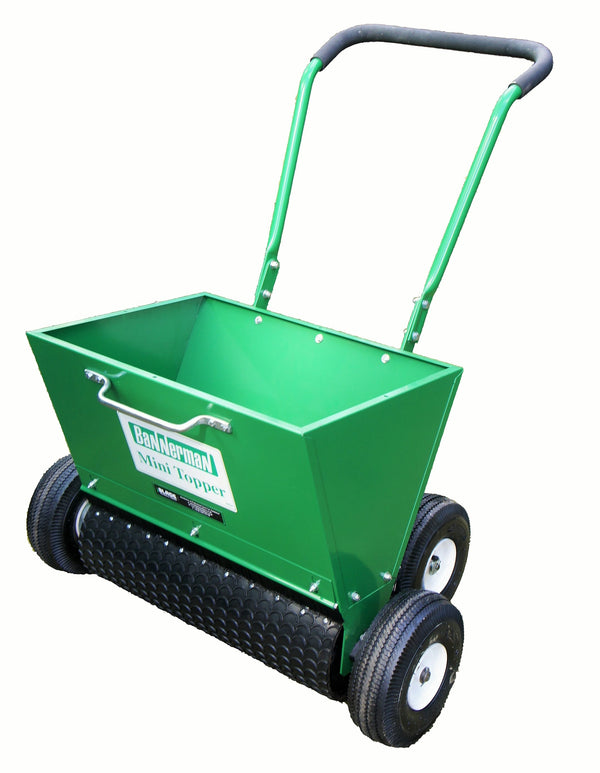
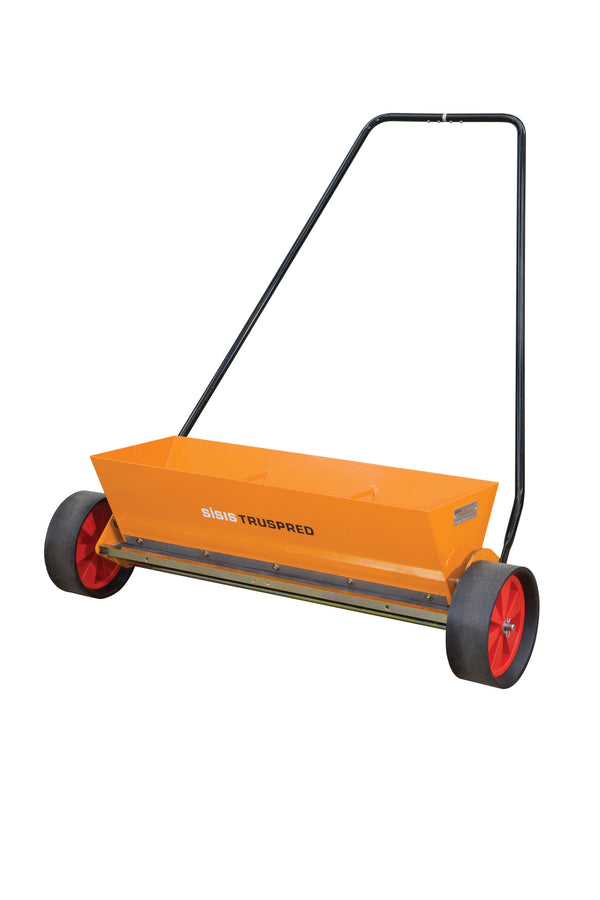
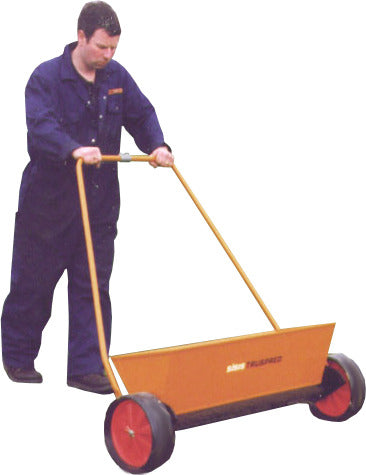
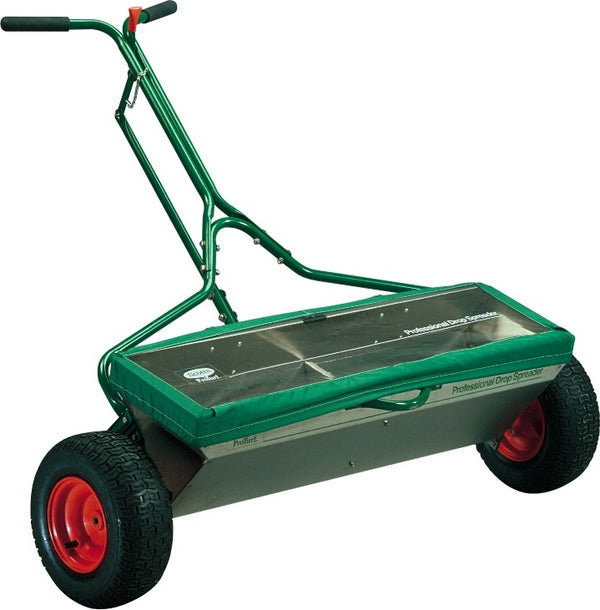
Drop Spreaders for Precise Granular Application
Drop Spreaders are built for control. When you need to place granular product exactly where it is needed, without throwing material far beyond the wheels, they are a very useful option. On sports turf, that level of accuracy matters. A drop spreader helps you apply seed, fertiliser or soil amendments in a neat, measured band, which is ideal for defined areas, tight edges and surfaces where product placement needs to stay tidy.
For football, rugby, cricket, golf and managed amenity turf, there are plenty of situations where accuracy matters more than outright speed. Touchlines, wicket surrounds, narrow passageways, goalmouth approaches, bowling-green edges and small renovation zones all benefit from a spreader that keeps product within a controlled working width. That is where Drop Spreaders come into their own. They are slower than broad-casting machines, but they make up for it with cleaner placement and reduced waste.
In practical grounds management, a drop spreader is often chosen when there is little room for error. If you are working near hard surfaces, ornamental beds, drainage channels or non-target areas, a more contained spread pattern helps keep the job professional. It also makes clean-up easier and supports better use of product across the season.
Why Drop Spreaders Matter in Turfcare
Accuracy over spread width
The difference between Drop Spreaders and broadcast machines is simple: instead of throwing granules out in a wide arc, a drop spreader releases them directly beneath the hopper in a controlled strip. That gives the operator much tighter control over where the material lands. On fine turf and closely managed sports areas, that can be a real advantage.
Accuracy is especially important when applying seed to thin or worn zones. If seed drifts too far outside the target area, you waste product and lose definition in the repair. The same goes for granular fertiliser or mini-granular inputs. With a drop spreader, you can keep the application neat and focused, which supports more even recovery and a cleaner visual finish.
That precision also helps when rates need to be closely managed. Hopper aperture, walking speed, granule size and material flow all affect output. Because the spread pattern is narrower and more defined, it is often easier to see where you have been and where the next pass needs to go. For many groundspersons, that makes calibration and overlap control more straightforward than with wider spinning-disc systems.
Useful on tight and sensitive areas
Drop Spreaders are particularly handy on smaller or more sensitive surfaces. A cricket square edge, golf collar, tennis surround, cemetery lawn, school sports area or estate path edge can all be awkward to treat with a machine that casts material broadly. A drop spreader keeps the application line cleaner and reduces the risk of granules landing where they are not wanted.
That has practical benefits: less product on pavements, less risk of scorch from accidental overlap, and better control around irrigation heads, covers, posts and built features. It is a simple piece of equipment, but on the right job it can improve both finish and efficiency.
Choosing the Right Drop Spreader
Start with the size of the areas you manage. If most of your work is localised and detail-focused, a compact pedestrian model may be all you need. If you regularly apply granular products across larger but still defined areas, a wider hopper and stronger chassis may be worth having. The best choice depends on the balance between precision, capacity and operator comfort.
Build quality matters here as well. Granular fertiliser dust, damp mornings and regular wash-downs can all shorten the life of poor-quality components. A durable hopper, reliable shut-off bar and corrosion-resistant frame will stand up much better to repeated use. Wheel quality matters too, because smooth forward movement helps keep output consistent and reduces jolting over uneven surfaces.
Look closely at the rate-setting mechanism. Easy, repeatable adjustment is important if different operators use the same machine or if you switch between seed and fertiliser during the year. Fine seed, coated seed, mini-granular fertiliser and larger granules all behave differently. A spreader that gives clear setting control makes those changes easier to manage and supports better application accuracy.
It is also worth thinking about visibility. With Drop Spreaders, the working width is often defined by the hopper and wheel position, so it helps if the operator can clearly line up each pass. Machines that are awkward to push or difficult to steer are harder to use consistently, especially on soft ground or recently prepared surfaces.
How Drop Spreaders Fit into the Grounds Programme
Drop Spreaders have a clear place in a wider maintenance programme. In spring, they are useful for tidy granular feeding and early overseeding in worn or weak areas. In summer, they support localised recovery work and controlled dry applications where accuracy matters more than speed. Through autumn, they are especially valuable during renovation, when seed and fertiliser often need to be placed carefully on prepared surfaces. In winter, their use is more selective, but they can still be helpful for dry products on suitable days and on defined, traffic-prone areas.
That seasonal flexibility makes them a solid addition to the shed. They do not replace every other spreading tool, but they fill an important gap between hand application and wider-area machinery. Where precise placement matters, they are often the better choice.
Professional insight from the turf side
On sports sites, the small margins often make the biggest difference. A neat renovation line, a cleanly fed wicket edge or a carefully overseeded wear strip can lift the whole presentation of the surface. Drop Spreaders are useful because they help you work neatly and deliberately. They support recovery without spreading product across areas that do not need it; that matters for both cost control and visual consistency.
They also fit well within integrated turf management. You might prepare a worn section, apply seed or fertiliser with a drop spreader, then use Handheld Spreaders for tighter touch-up work or Broadcast Spreaders where wider coverage is more efficient. On programmes that combine dry and liquid inputs, they also sit neatly alongside Pedestrian Sprayers. That kind of joined-up working is what keeps surfaces improving over time. Precision application is not just about being tidy; it is about helping the plant respond evenly and giving the surface the best chance to recover under use.
Drop Spreaders are simple, dependable machines that help you place dry products accurately across sports turf and managed grass. Choose one that suits your surface size, product type and working pattern; then keep it calibrated, clean and ready to go. Used well, it is a very effective tool for accurate granular application throughout the season.
Recently viewed